
The first time I stood in front of a painting by Mary Cassatt, something quietly shifted for me.
I had studied art history for years. I loved museums. I could talk confidently about movements, styles, and “important” artists. And yet, standing there, I realized how unfamiliar this moment felt — how rarely I had paused to truly see the work of a woman artist, or to question why so few women had been centered in the stories I had learned.
That realization stayed with me. And eventually, it became a question I couldn’t stop asking.
A simple exercise with surprising results
Out of that reflection came a very simple activity — one we now use in Art History in the Park workshops and invite families to try at home.
It begins with two prompts:
Name five artworks or images you’re aware of that depict women.
Then, name five female artists.
There are no right or wrong answers. No pressure. No grades.
What happens next is the most interesting part.
Often, the first list comes easily. The second takes longer. Sometimes much longer. For adults and children alike.
That pause — that moment of noticing — opens the door to meaningful conversation:
Why do some images come to mind so quickly?
Where did we first see them?
Whose stories were we taught to remember?
And whose were quietly left out?
Why awareness matters (especially for children)
At Art History in the Park, we believe art history is not just about memorizing names or dates. It’s about learning how stories are shaped — and how awareness can change what we see.
Children are incredibly perceptive. When we invite them into these conversations early, they begin to understand that history is not fixed or complete. It is something we continue to look at, question, and expand.
This isn’t about blame or guilt. It’s about curiosity.
When families sit together and realize, “We know fewer women artists than we expected,” the question naturally follows:
Why might that be?
And from there, learning becomes alive.
From Mary Cassatt to a bigger picture
Mary Cassatt often becomes a powerful entry point into this conversation. She painted everyday moments of women and children with tenderness and intention — scenes that were deeply familiar, yet rarely celebrated in the same way as the heroic or monumental subjects favored by her male peers.
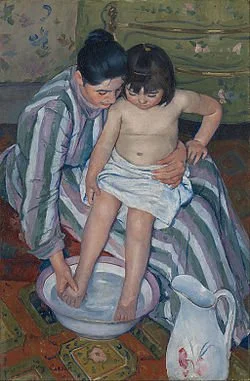
The Child’s Bath by Mary Cassatt (1893)
An everyday moment in the life of a mother, made worthy of close attention.
Her work helps us ask:
What subjects were considered worthy of art?
Who was given space to tell stories?
And how might our understanding of art history shift if we widen the lens?
From Cassatt, families often become curious about other women artists — across cultures, time periods, and styles. Awareness grows not because we force it, but because curiosity has been sparked.
A free invitation to reflect together
To support these conversations, we created a free Women in Art Awareness Survey that families, classrooms, and community groups can use together.
The activity is designed to be:
Short and accessible
Open-ended and discussion-based
Suitable for children, teens, and adults
You can download the PDF below and try it at home, at school, or during a visit to a museum.
